When the system fears the truth: why human rights defenders are followed after monitoring visits
There are things that almost never make it into official reports. They are not written in dry language in briefing notes, nor are they featured in press releases or discussed at collegiums. Yet, it is precisely such episodes that most accurately demonstrate how Ukraine’s penitentiary system actually functions.
On 23 April 2026, a series of monitoring visits to institutions in Kharkiv and Sumy oblasts concluded. Several facilities in a row, without breaks and without ‘convenient’ routes. These were not formal tick-box exercises. In a number of institutions, we had to ask uncomfortable questions, check documents, and analyse the organisation of convicts’ work, conditions of detention, calculation of payments, medical provision, and the actions of the administrations.
When you conduct such visits one after another, the illusion that the problems are isolated quickly vanishes. Something else becomes obvious: this is not about coincidences or individual manifestations of the ‘human factor’. It is about the system: vertical, closed, and interconnected.
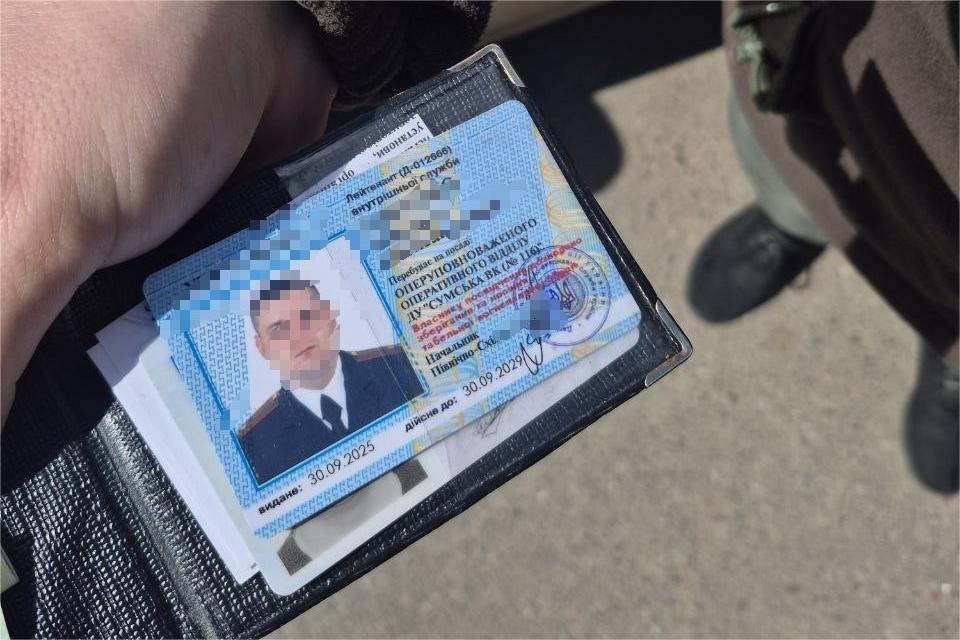
After completing the monitoring visit to the State Institution ‘Sumy Correctional Colony No. 116’, at around 14:00, while returning to the hotel, we noticed a white car with the registration plate BM 5123 ST following us. The car maintained its distance, mirrored our route, and reacted to changes in direction. To make sure it was not a mere coincidence, we altered our route and pulled into an alleyway; the white car followed us in and stopped.

A representative of our monitoring group approached the driver, introduced himself, and asked him to explain the reason for the pursuit. Behind the wheel was a man in the uniform of the State Penitentiary Service, who produced his ID. It turned out to be an officer of the operational department of the very institution the monitors had just visited. He was unable to provide a clear explanation for his actions.

And this is where the core of the matter begins.
This is not a story about a single officer in uniform. This is a story about decisions. In a structure with strict subordination, an operational officer does not drive around the city tailing public monitors on his own initiative. Such actions are either directly authorised or part of a tacitly approved practice.
And this is not the first case. Similar episodes have already been recorded after visits to institutions of the North-Eastern Interregional Department. When recurring patterns become a habit, they cease to be mere incidents and turn into a method.
A logical question arises: why does the system react in this exact way?
Not because of comments about the paint on the walls or the condition of the premises. Not because of minor domestic details. The reason runs much deeper.
Monitoring groups operate where the system is most vulnerable: in the area of convicts’ labour, where there are often signs of forced labour; in matters of payments that do not correspond to the actual volume of work performed; in the calculation of the single social contribution, which is sometimes purely formal; in internal financial flows that shun publicity; in the catering sector, which often fails to meet even basic standards; and in cases of ill-treatment that do not make it into official statistics.
The system can live for years with criticism of detention conditions. It can ignore remarks about daily living standards. But it reacts very nervously when someone starts counting money, analysing documents, and raising questions about accountability.
It is at this very moment that a human rights defender ceases to be an ‘inconvenient visitor’ and becomes a threat.
Then, ‘accompaniment’ appears. Not direct pressure, not open detention, not a public conflict. Instead, a signal: we see you.
However, there is another fundamentally important aspect to this story. The entire monitoring group held not only the status of public monitors but also proper journalist credentials. The group included Serhiy Zuikov, an assistant to a People’s Deputy and a member of the Public Council under the Ministry of Justice of Ukraine; Oleh Tsvilyi, a member of the Public Council under the Ministry of Justice and a journalist; and Andriy Didenko, an assistant to a People’s Deputy and a journalist.
This means we are dealing not only with individuals exercising public oversight of the activities of penitentiary institutions, but also with media representatives performing their lawful professional duties: gathering information, documenting facts, and preparing materials on human rights compliance and the functioning of state bodies.
Consequently, any unlawful surveillance, obstruction of work, pressure, or harassment of members of such a group may have not only disciplinary consequences but also constitute a criminal offence associated with obstructing the lawful professional activities of journalists. When officials forget this, they risk crossing the line between ‘internal initiative’ and accountability under the law.
The staffing issue deserves separate attention. In recent years, the penitentiary system has increasingly been filled with individuals coming from police internal security units and related law enforcement agencies. These are people with experience in operational control, surveillance, and internal investigations, but who often lack a proper understanding of the specific nature of the execution of sentences, resocialisation, human rights, and international standards on the treatment of prisoners.
As a result, colonies and remand prisons begin to be perceived not as institutions where the state executes sentences within the boundaries of the law, but as closed facilities of law-enforcement administration. Instead of developing a modern penitentiary model, the system adopts the logic of an operational regime: control, suspicion, fear of external oversight, and hostility towards public scrutiny.
That is why human rights defenders are followed after monitoring visits. That is why surveillance occurs instead of answers. That is why silence prevails instead of openness.
But as long as there is publicity, this will not become a mere formality. And if, after a series of visits in Kharkiv and Sumy oblasts, the system’s reaction looks exactly like this, then the right questions were asked.
Those questions to which it is still not ready to respond.