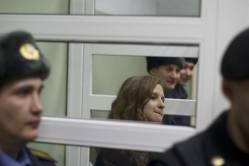
Maria Alyokhina: I Was Disciplined for Invoking Article 51 of the Constitution
Alexander Podrabinek speaks with Maria Alyokhina, one of the members of the group Pussy Riot, who is currently incarcerated. Maria Alyokhina talks about the conditions of her detention in the penal colony. The court in the town of Berezniki, Perm Krai, rejected her request for a postponement of her sentence on the grounds that she has a small child.
RFI: Tell me, what are the conditions of your detention like?
Maria Alyokhina: The conditions are acceptable. That is, naturally, I am under special supervision, I am a special case: even my most minute actions are documented and presented to me for signature. And this is done with the aim of showing me that in this colony, everyone acts according to the law. They isolated me, placed me in a ‘safe place’—in essence, it is a cell in the cell-type facility (PKT)—so that I would not see how the colony actually lives.
RFI: Are you not being held in the PKT regime? Is it the general regime?
Maria Alyokhina: No, I am being held in a ‘safe place’.
RFI: Are you alone in the cell?
Maria Alyokhina: Yes. Behind an iron door. I have two walks a day.
RFI: Of half an hour each?
Maria Alyokhina: An hour each.
RFI: Was that your initiative or the administration's?
Maria Alyokhina: It is a rather complicated story. It began when I was transferred from quarantine to a detachment, and a day and a half later, five people from quarantine and other detachments were moved there, and they staged a provocation. It was in the evening—shortly before roll call. I was shocked by this situation; I went to the operations officer, explained the situation, and asked for measures to be taken, as I had been threatened with physical violence.
I want to say immediately that this had nothing to do with religion; it was linked to the fact that these people claimed that after I arrived at the colony, the colony—as they put it—began to be “tightened”. That is, they began to strengthen the regime, and the indulgences they had before my arrival were taken away from them. And they were very unhappy about this.
At first, they suggested declaring a joint hunger strike, but I felt it was a provocation and refused to talk to them at all. After which they began to threaten me and say that this was all my fault and that I should go and sort it out.
I went and explained the situation to the operations officer and asked for it to be resolved. And then he dictated to me—he said I needed to write a request—for a ‘safe place’. I did that. But, naturally, no one explained that a ‘safe place’ is a solitary confinement cell (SHIZO). He said it would not be for long, that formally it was for up to 90 days. But this ‘not for long’ is still going on, until the administration figures things out.
Afterwards, I found out from certain sources that it had all been planned by the operations department. I realised this the very next morning, as I had been thinking about it all night. And then the Human Rights Ombudsman called me—she requested a video call so they could contact me. And they arrived.
That same day, the supervising prosecutor arrived. I explained the whole situation to them and said that, as far as I am aware, the people who threatened me have not been punished, while I am essentially in conditions where I am the one being punished. In the end, they faced a formal punishment—they were put in SHIZO for 5 days. For 5 days. After I kept saying that I did not like the situation, I found out that they were not moved to any other detachment and that they are, in essence, like all the other prisoners.
RFI: When does the 90-day period expire?
Maria Alyokhina: 21 February.
RFI: And what will happen next?
Maria Alyokhina: One can assume what might happen. But I have a somewhat paranoid assumption that they will claim I am in danger in this colony and they will transfer me to another one. I fear this very much, as I have 80 kilograms of belongings. I would have to drag them. Belongings here act as a symbol, because this baggage is also psychological.
RFI: Does solitary confinement not depress you?
Maria Alyokhina: I have some interaction in the vocational school where I sew, and I can somehow learn about life in the colony. But, of course, it is not enough. I wrote written requests asking to attend the gym, to participate in mass events, and to organise mass events. I was given a written refusal signed by the head.
RFI: And what do you have in your cell?
Maria Alyokhina: I managed to get them to allow me to have ‘civilian’ appliances. And even then, it was with great difficulty, but I did it. They let me have a television, a tape recorder, and a kettle. And they installed a power socket for me. I had to create a long-running scandal for that, and spend a long time saying that I would file complaints. That is, they installed the socket on the very first day, but I lived with an immersion heater for over a month. And then I kept saying that the code states such and such.
RFI: Does the prosecutor overseeing places of detention visit you?
Maria Alyokhina: He has visited. But there is a Berezniki supervising prosecutor; he wrote to me yesterday. Then the supervising prosecutor for Perm Krai visited me, once as well. As far as I know, they requested some documents, but the point is that no one gave me any answers.
And the same—alas!—was done by the chairman of the public monitoring commission. He was the first person to visit me when I was still in quarantine. He gave the impression of being a very tired person; as far as I understand, he has been working for a very long time. We talked, and a member of the Federal Penitentiary Service (UFSIN) responsible for human rights was nearby. He recorded everything—I spoke with him for a very long time, about an hour and a half.
I told him about the living conditions; I just felt it was my duty, because my situation allows me to write and be heard, to speak and be heard. Others do not have that opportunity. I spoke about material support. That is, about the fact that headscarves provided for winter time resemble gauze more than anything else. I talked to him a lot about that. I spoke about low wages.
RFI: And what is your salary?
Maria Alyokhina: I know what people get in their hands. The best salary, which a foreman or a skilled worker gets, is 1,000 roubles.
RFI: Per month?
Maria Alyokhina: Yes, naturally, per month. Many get 100, 200, or 500 roubles. That is, it is impossible to live on this, obviously. That is clear. I could not provide evidence as I was in quarantine. I would have brought it if I had been in the detachment longer; I would have obtained those slips that are given to convicts. But I was ‘removed’ in time.
RFI: What complaints about the conditions of detention do you have now?
Maria Alyokhina: I do not have any, but this concerns how all the other people live. Special conditions are created for me: my requests are accepted and reviewed, and my complaints go through. But I am sure, I know, that such a situation does not happen for the other convicts. And, as more important issues, one can consider parole.
RFI: Are you hoping to be released on parole?
Maria Alyokhina: No, I am not hoping. I am not hoping for anything at all. I have no hope; having seen this judicial system, I hope for nothing. I am simply outraged by the fact that people are manipulated through physical freedom, through this parole, and being in the position of slaves, they silently agree and do not challenge it at all. This system, the administration-convict situation, mirrors each other and continues the line of the official regime.
RFI: What are the disciplinary penalties imposed on you related to?
Maria Alyokhina: I have received 4 penalties in the colony—3 verbal, one written. Twice they accused me of not getting up at reveille, even though I simply did not hear the signal.
RFI: Was this already in this cell?
Maria Alyokhina: Yes, in the cell. The thing is, no signal is played. I am behind a reinforced door; an officer approaches the door and says: “Alyokhina, wake up.” I will not comment on the volume at which he says this. That is, I simply did not hear him at 5:30. When they opened the door at 5:45, I heard it and stood up immediately and apologised several times. But—alas! A report was written.
RFI: Was that a remark or was a penalty imposed?
Maria Alyokhina: Yes, of course, a penalty. Then a disciplinary commission, a humiliating procedure before a disciplinary commission.
RFI: And what did the penalty consist of? SHIZO?
Maria Alyokhina: The penalty follows a gradation: first a verbal reprimand, a written reprimand, then SHIZO.
RFI: But you haven't been in SHIZO even once?
Maria Alyokhina: Not yet. The next penalty was imposed because I was carrying my personal notes to my lawyer, and during a search, I handed them to an officer with my own hands and said that if these personal notes needed to be read by the operative, let him read them now. This is urgent information, these are my personal notes; I am not going to give them away, I want to take them with me to the cell, but I need to convey urgent information.
Well, they took these notes away from me, wrote a report, and for an hour and a half, the operations officer tried to dictate an explanation to me—that is, what I needed to write in my own explanation. I wrote my own. But that was the fact of the matter.
And I received the last violation for so-called “backtalk”; when they summoned me to the last disciplinary commission, I realised that this commission was not being held to sort out the situation, but simply to punish a person. I said that until my lawyer was admitted—and I asked for legal assistance throughout the entire commission—I would invoke Article 51 of the Constitution: I will not testify against myself. And this was ‘backtalk’. For that, I was disciplined for using Article 51 of the Constitution.
RFI: What is your mood in general? The general feeling.
Maria Alyokhina: General? I like it. Because a trip to the prison is a kind of holiday. (laughs). One can lie in bed, etc. Well, what can I do, I will return to the colony and continue living there. I already have a number of things there that I have not finished; I will need to take care of them. For example, my foreign correspondence was taken away, and I want to work on having them hire a translator; if they do not do that, I will complain.
RFI: Were there letters in other languages?
Maria Alyokhina: Yes. But the thing is, during transfer they are obliged to give everything back. They did not do that. They just left it in the operations department. There are a number of other things that definitely need to be dealt with. Plus—we have filed a statement challenging these disciplinary penalties; we will contest them, we will go to court. Those are the plans. But, of course, I am very glad that I have the opportunity to read a lot, to write, and to be in solitude. For me, this is very important.
RFI: Are your notes not confiscated? Did that not happen?
Maria Alyokhina: They are not confiscated. But the operatives come with a search from time to time—you come to the cell, and it is all torn apart, everything turned upside down. I have all my papers very clearly sorted in files and folders—all of this gets mixed up. I have to spend several hours sorting them again. These are very unpleasant things. This needs to be challenged at a high level so that if searches are carried out, the order in the cell remains the same as it was before the search. After all, no one gives them the right...
RFI: There is a large international campaign in your defence. You know about this. How do you imagine this reflects on your situation? If it does reflect, then in what way?
Maria Alyokhina: I think it reflects in the sense that the administration is somewhat bewildered, and I even feel a little sorry for them. For every little thing, they are forced to write papers and work, which they usually do not do. They are not used to doing this, but here they are forced to work hard (laughs).
RFI: How is your health?
Maria Alyokhina: I experienced a certain amount of stress in connection with the imposition of penalties and, in general, with the procedures I saw in the colony. Because it is obvious that there is the law, and then there is how things really are. And I do not like how things really are at all. Furthermore, I have a certain quirk: I want to see things done according to the law here and now, because that is how it should be.
RFI: Do you have any health complaints now? Or are there any?
Maria Alyokhina: Well, during this time, my eyesight has dropped by 3 or 4—I do not know what they call it—units?
RFI: Have you consulted an ophthalmologist?
Maria Alyokhina: They do not have an ophthalmologist.
RFI: Did you ask for a consultation?
Maria Alyokhina: Yes, of course.
RFI: They are not providing one?
Maria Alyokhina: They say he comes once every six months. Well, we are waiting. They put me on the waiting list.