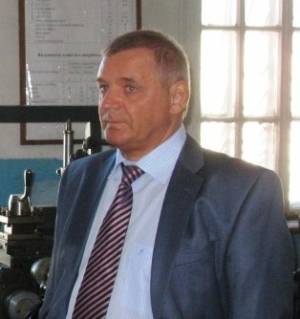
Interview with the Head of the State Department Office for Implementation of Sentences in Kharkiv Region
In May 2010, Anatoly Slipchenko was appointed head of the State Department office for the implementation of sentences in Kharkiv region. Previously, he worked at the Ministry of Internal Affairs, where he rose from the head of the criminal investigation department of the city Ministry of Internal Affairs to the head of the Main Office of the Ministry of Internal Affairs of Ukraine in Kharkiv region. Did the former chief police officer of the region like his new work and what new developments should be expected in his sphere of responsibility? A. Slipchenko told the correspondent of "SQ".
"To make clear what we are talking about, tell us how many criminals are held in Kharkiv region?"
"On the territory of Kharkiv region, 11 penal institutions operate, a detention centre and the Kuryazh educational colony for juvenile offenders. As of 20 October 2010, they hold 11.8 thousand convicted and detained persons in total. Of this total, approximately 3,000 persons awaiting trial are held in the detention centre, whose sentences have not yet become final. The total number of persons held in our departments is not constant and fluctuates within 11,000 to 12,000 people."
"In Temnovsk Penal Colony (No. 100), a high-security sector has been created for the detention of men serving life sentences. At Kachanovsk Penal Colony (No. 54), a medium-security sector has been created for women serving life sentences. The institutions in the region hold 3 leaders of organised criminal groups, 1 criminal authority, 13 persons convicted of gangsterism, 830 persons for murder (including 31 for contract killing), 3 persons prone to taking hostages, 115 persons sentenced to life imprisonment."
"Moreover, 37 criminal execution inspection departments operate in the region, with 12.5 thousand persons registered with them. This category of persons serves their sentences without deprivation of liberty: they are engaged in public and corrective work, they are prohibited from holding certain positions or engaging in certain types of activity."
"What mainly drives a person to commit a crime?"
"The motives for crimes can be very different – criminology identifies up to 300 such factors. From the most trivial, when difficult living conditions and inability to earn a living honestly lead to a breach of the law, to those caused by laziness, vulgarity or outright greed. Regularly communicating with our charges, I understand that each person has their own path that led them to confinement. For example, many underage boys, who are unprepared for a difficult life, have stumbled because of a desire to have an expensive mobile phone or, worse still, because of the need simply to eat! I can give an example when a child committed thefts at kiosks because he simply had nothing to eat. His mother was alone with five children, and as a result the street became the child's home. First, he stole corn snacks, and then he set his sights on something more substantial and received a sentence."
"Examining the personality of such a child, one understands that, perhaps, our laws in practice are far from perfect, plus family upbringing has largely ceased to be the fundamental mechanism for cultivating a law-abiding citizen. With such boys, I apply maximum effort so they find themselves in this life, gain a profession. The colony has all the possibilities for this: a comprehensive school operates, there is a vocational training college branch, there is a good library, educators work with the teenagers."
"Indeed, many convicted persons serve sentences for minor crimes, such as theft of mobile phones, bicycles, household items, etc. If we speak on this topic, certainly one feels sorry for the crime victim, the person robbed on the street, but is it fair to give a sentence for a mobile phone? In any case, we are executing a court sentence, and to reason about the degree of guilt of criminals is not our prerogative. And we should not forget that, of course, there are also such categories of people who have committed serious and particularly serious crimes, and more than once!"
"Female crime also requires separate careful study. As with teenagers, this category of convicted persons requires particularly delicate work. After all, the majority of them are not only responsible for themselves but also for their children. When you hear that a woman is sentenced to 9 or 10 years for murder, the stereotype paints a hardened criminal with an aggressive facial expression. But when you start to look into it, it turns out that in a state of nervous breakdown the woman killed her husband (or cohabitant), who had long abused her and constantly beaten her. Many of them certainly appealed for help to the police or to the authorities, but, unfortunately, the articles of the law "On the Prevention of Domestic Violence" have not yet worked effectively with us. As a result, the woman sees no other way out but to commit a crime. There are quite a lot of such murders and, in my opinion, the courts need to take a somewhat softer approach to deciding the further fate of women who have stumbled. However, so that the impression is not merely of "disadvantaged" convicted persons, there are other examples. We hold a woman who killed five people. The crimes were so carefully planned and prepared that they can be called professional."
"How do your staff cope with such charges? Are there cases of cruel or harsh treatment of convicts by staff?"
"I have been in this position for five months now, and not a single such case has been recorded so far. I would even note a trend towards a significant reduction in the use of special equipment and punishments. An operational service and a social and psychological service work with prisoners, which prevent conflicts, stabilise and improve the moral and psychological climate among the convicted population. For us, there is no division into "good" or "bad" convicts; all are equal before the law, and this is one of the main things we strive to instil in them. Although, undoubtedly, within the general mass of convicted persons, one can immediately see who lives by the principle "my home is a prison" and who is responsive to education. I think that there is a need to do more work on humanising the penal system and not keep behind bars persons who no longer present a danger to society."
"According to assessments by foreign experts, Ukraine punishes too many people with deprivation of liberty. Is it planned to change this practice?"
"Many people are now talking about reforming law enforcement, and our service is part of this system. In order for reform to really begin, it is necessary to decriminalise a number of articles in the Criminal Code. The Criminal Code should have been revised long ago, as a significant part of its articles simply do not work. We keep returning to the problem of the gap between theory and practice. Legislators need to take a more precise approach to defining the measure of responsibility, investigation and the serving of sentences. The problem needs to be solved comprehensively."
"You used to catch criminals, and now you guard them. Will police officers like it if convicted persons start to be released from custody?"
"No one will be released just like that; there is a law and responsibility for its violation. To date, the legislation provides for the possibility of early release of those deprived of liberty. But the practice of applying conditional early release must be approached extremely carefully. It is not enough for a convicted person simply to have served part of the period established by law; for consideration of the appropriateness of applying conditional early release, he must work diligently, study, have exemplary behaviour. We strive to explain to each person that the main aim is to set on the path of correction and be released conditionally early, serve his sentence and never come back here again. At the same time, I emphasise that it is not we who release convicted persons for conditional early release; this is exclusively the court's prerogative; the colonies merely prepare the corresponding materials. Very few of those who left on conditional early release end up back in prisons. We specifically analysed who committed crimes again after conditional early release. In Kharkiv region, there were about 40 such persons in the first half of 2010."
"Besides the social effect, the reform will also have an economic effect. The fewer criminals, the less money is needed to maintain them. But how are penal institutions currently financed?"
"Our need for budget financing fluctuates within 300 million hryvnia per year. From the state budget, 50 to 60 per cent is allocated; the remaining funds are earned by the colonies through their own production. True, there are other problems associated with tax payments. From previous years, the management has a creditor debt of 37 million hryvnia, including 20 million hryvnia in debt for energy resources, to the Pension Fund and the tax office. Debts began to accumulate due to very weak financing about 10 years ago. Debts are partially being paid off, but they are not decreasing as new fines and penalties accumulate. We are contesting the fines."
"Income from production covers budget items that the state itself underfunded. Colonies incur production costs for paying wages, energy, materials, and there are no funds left for paying tax contributions. This means that mutual settlements, restructuring or a special approach to taxing the colonies is needed. In no other CIS country is the penitentiary system taxed; why is ours? We submitted our proposals when the Tax Code project was being discussed, but whether they will be accepted is unknown. It is known that in the Tax Code project that passed the first reading in the Supreme Rada, there is little good news for us…"
"Where do the colonies get orders?"
"I feel strong support from the Kharkiv regional state administration and the leadership of Kharkiv city council in terms of providing the colonies with orders. Now there is the possibility of producing for the city's needs lighting supports, fencing for embankment improvements, benches, rubbish bins, sewer lids, paving slabs. Over the past three months, orders worth almost 5 million hryvnia have been received. We will also make children's playgrounds. Working with designers and specialists, we are developing an experimental model of a very beautiful children's playground. We need to ensure that children are not injured, that the equipment is durable and can be easily repaired. We are grateful to the city for keeping our contingent employed because, for the imprisoned, labour is not simply earning money but also an element of resocialisation. This is very important for a person who has been in isolation for a long time, especially if sentences are 10, 12 or 15 years. Women in the colony cannot imagine themselves without work. They come and ask – give us work! But now the capacity utilisation of the colonies is 20 per cent of the possibilities we have."
"Are there problems in staffing the colonies?"
"There are certain problems in recruiting junior inspection staff, who provide security on towers and posts inside the colonies. The problem is connected with the fact that their salary is on average 1,300 hryvnia. Very many young people who work as junior inspectors are residents of remote villages where there is no other work. Many come to work with us to make a career, want to study and become officers. They start as junior inspectors and become majors and lieutenant colonels."
"But still, staff turnover among junior inspectors is around 30 per cent, and this is bad. After all, we incur costs in selecting people and training them at state expense, during which they study the regulatory framework and master the specifics of their work. And then a person has learned everything, understood everything, worked for 1 to 2 months and realises that psychologically they cannot cope. And then family circumstances change and the salary is low, so they resign."
"There are no particular problems in recruiting officer personnel. These specialists are trained at the National Law Academy named after Yaroslav the Wise, where about 150 specialists are graduated per year for the entire penal system; about 20 specialists remain to work in Kharkiv region."
"What new initiatives do you plan to implement in the work of the service?"
"It so happened historically that Kharkiv detention centre is overcrowded by approximately 300 to 500 persons. At the same time, previously in the detention centre were held people sentenced to arrest as a type of punishment. We created, on the basis of Dikanka Penal Colony No. 12, an arrest house designed to hold 60 people. Currently, the arrest house holds 35 persons. We have begun work on creating temporary detention centres on the territory of existing colonies. It is planned to hold about 200 more persons in these detention centres. There are plans to build a building in the detention centre that would solve the problem of overcrowding of the institution and address a number of other issues. Construction of the building was started in previous years (so far there is only the foundation), but now it has been frozen due to lack of financing."
"In November, a social centre for women released from places of deprivation of liberty will open. It is being created in Krasnopavlovka settlement (Lozova district, Kharkiv region) with a grant provided by a Swedish charitable organisation. The centre will house those who have been released but have no accommodation. On average, one woman is released from places of deprivation of liberty per month who has nowhere to live. Social workers and psychologists will work with the women in the centre. After the centre is put into operation, it will be transferred to the relevant office of the Kharkiv regional state administration…"
"Now I have been entrusted with leading a department that needed to be raised to a qualitatively new level, and I believe that, together with the team I have retained, we will be able to do this."
"Were there any staff changes at the regional office of the State Department for Implementation of Sentences after your appointment?"
"Before my appointment, there were staff changes about three years ago. Since then, all heads of departments have remained in their positions; only after my arrival have they started working at a higher level. I can confidently say that much has been accomplished in the past five months. The "weak points" were identified, and the efforts of the staff were directed towards eliminating problems in the organisation of work. This includes keeping the colonies at full capacity, internal order, rational use of funds and computerisation. The office now has the ability to hold conference calls, communicate with all heads of colonies and promptly solve emerging problems. There is no need to write and distribute unnecessary papers or spend time on phone calls. The heads of colonies receive fresh information and respond promptly."
"What other new initiatives are planned?"
"There are plans to install modern production lines in the colonies, similar to those, for example, in Colony No. 100. There, a line for manufacturing plastic sewer lids operates. Due to the fact that the equipment is of high quality, the average salary of a prisoner working on this line is approximately 850 hryvnia per month. This is quite substantial given that his housing problems are solved – he has somewhere to sleep, he is provided with food. Money is not handed out but directed to a card, by which the prisoner can buy goods in the colonies' shops or send funds to relatives, to children at home."
"I do not regret switching to work at the State Department office. I believe that I have managed, without exaggeration, to breathe new life into its work."
"Will luxury cells be created in the detention centre for those who can pay?"
"For us, there is no difference whether a convicted person has some means or not. The conditions of detention, both in colonies and in the detention centre, are created according to the same principle – block-type accommodation, the same for all categories. We strive to carefully plan how to approach the reconstruction of the entire detention centre, which has needed it for a very long time. The difficulty is that this institution operates very intensively: there are days when 400 persons are admitted and 400 are released. As for meals in the detention centre, their quality is monitored by a number of authorities, including the sanitary and epidemiological service; there is also our own supply service. Our staff go on foreign business trips to learn from the best practices. A staff member who recently returned from London said that in that country prisoners do not work, but colonies receive full state budget financing; inside colonies and prisons there are sports facilities, prisoners are held in two- to four-person rooms. Prisons are built according to new modern designs. We cannot reach such a level now, but work to improve the conditions of detention of prisoners in our colonies does not stop. Institutions are finding their own funds for reconstruction and repairs and are performing the work themselves. Prisoner accommodation is equipped with sanitary facilities; three-tier bunk beds are long a thing of the past. This is the result of serious work, and, having reached this level, we will only raise the bar further."